Monday, September 3, 2012

Majority of India prefer arrange marriages and joint families

According NDTV mid term poll 74% Indians prefer arrange marriages and 89% Indians prefer joint families


.


Wednesday, May 23, 2012

Satyamev jayate and its effect on people

I am in no way Criticising Satyamev Jayate ..What Aamir Khan is doing is very good .But after visiting blogs and some sites a question comes to my mind,What is so special about satyamev jayate? Satyamev Jayatey is not the first show that is highlighting these social.There are Tv shows on Lok Sabha Tv and DD where several discussions do take place.There is also typical show like Satyamev Jayate on CNN IBN , Zindagi live which is running from past 4-5 years.The show is very similar to SMJT .But I have hardly or never seen any discussions taking place about these shows.Are we society where we need bollywood stars to tell what are our social problems? Only then we will discuss about these issues.

Saturday, May 19, 2012


Mamata walks out of show, calls students Maoists


Where is Indian democracy heading? Indian politicians are becoming more and more intolerant


Thursday, May 17, 2012

Income Taxes paid by Indians [Overview, Numbers & Graphs]


Do you know how many Indians pay Taxes and how much?

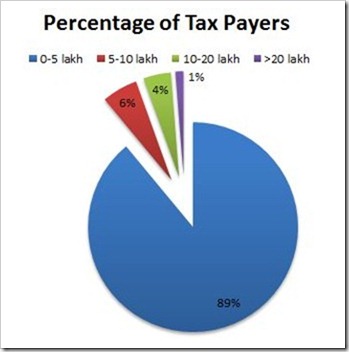
You would be surprised with some of the numbers. According to the report released by Indian Finance Ministry, estimated number of taxpayers for financial year 2011-12 stands at just 3.24 Crore people. That means, less than 3 people in 100 pay taxes

Out of these 3.25 Crore people, 89% pay taxes in the tax slab of 0 – 5 Lakh rupees, while on the other end of spectrum, only 1.3% of all tax payers have income about 20 Lakh!
Number of Tax Payers in India & their Slabs

Slab Number(in lakhs) Percentage of taxpayers
0-5 Lakh288.4489%
5-10 lakh17.885.5%
10-20 lakh13.784.30


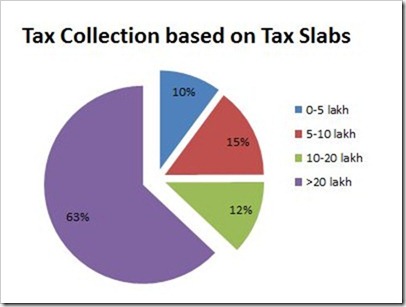
This next graph will show you further how much wealth is concentrated amongst only a miniscule few!


Wednesday, May 16, 2012

Voice Of The People

link


http://www.the-nri.com/index.php/2012/05/voice-of-the-people/comment-page-1/#comment-11386


When the opinion of the unattractive sweaty Indian is less important than that of his better looking, English speaking, compatriot.
Diesel prices had gone up, and the input desk at NDTV in New Delhi had dispatched me to get reactions from customers at a gas station. Vox pop, they call it in the business, the voice of the people. I was interning in reporting that very hot month of June, so off I went. I picked up a memory chip for the camera from the video tape library, I arranged for a cameraperson, and I arranged for a car. We stopped outside a gas station at Nehru Place, and we decided to get reactions from the folks that would drive up to the diesel pump there. The red-and-gold OB van with NDTV written in huge letters on its sides that had accompanied us was parked right outside the gas station, and we’d uplink the footage back to the newsroom from there. Sounded simple enough.

Except that it was Saturday morning. Except this was diesel. Only a handful of people passed through the gas station for diesel that whole couple of hours, but I did speak to them and uplink their reactions back to the newsroom. The quiet cameraperson – a dark-skinned man with weather-beaten skin – and I had thought that we were done, but I received a call from the edit bay telling me that the reactions I had got were not good enough and that I’d have to get more. I can’t remember exactly what I was told was lacking in the footage, but I remember the gist of it: the people didn’t look good/educated enough for TV. They spoke Hindi too. There’s a word for that in India: ghhaati. Low class.

But it was a story about diesel. The only people who bought diesel at gas stations were truck drivers, autorickshaw drivers…and other people’s drivers in general. Weren’t these the people whose reactions you’d want in a story about diesel? They were the ones who’d be affected by the price rise, right? I didn’t understand the issue with the Hindi either. Sure, we were an English channel, but we subtitled non-English footage all the time. It was not a big deal, so what was so different this time? I’d tried explaining that to the person who’d called me from the newsroom, but I was very silkily asked to just get some English bites from better-looking people who weren’t uneducated drivers.

I got it. They wanted freshly-scrubbed white-collar reactions for the white-collar-catering Inglis channel. Didn’t matter if white-collar India didn’t care about diesel prices.

I hung up and looked at the quiet cameraman. Camerapeople remind me of Rambo sometimes with those huge machine-gun-like cameras resting on their shoulders. They also remind me of the boombox-carrying kids from the ghettoes of America. My cameraman looked bored, emotionally disconnected. Cynical even. He wore what camerapeople, who are mostly men, wear around India – loose trousers, a loose button-down shirt with the sleeves rolled-up, and heavy shoes. All of it eventually a strange shade of don’t-care. The colour of Delhi. “Kya karein (what do we do)?” I asked him. The newsroom wanted reactions from mall-going Indians. But that still didn’t change things on the ground. It was still Saturday morning, hardly anyone was coming through the gas station, and almost nobody was passing through for diesel. Nobody that was English-TV-worthy, that is.

The cameraman shrugged as much as he could shrug with Rambo’s machine gun on his shoulder, not completely unlike Jesus wincing under the weight of the crucifix on his back. He looked a bit cross. He suggested I go pull a customer from the petrol pump where all the nice sedans were rolling in with their upper-middle-class-and-higher clientele. The English-speakers of India. I felt a little ridiculous. My intelligence and integrity felt vaguely insulted, but I still went. I put my Hindi aside and put on my best American accent because I was representing an English news channel to the English-speaking persons of India. “Oh, NDTV!” they’d say with an appreciative smile, “of course, what do you need to know?” I got reactions in English from an elderly ex-army Sardar gentleman, a bearded intellectual type, and an outspoken clean-shaven polo-shirt-wearing man with a sharp haircut. I felt a bit empty standing there with my mic with the red NDTV muff on it, smiling and encouraging the people along on their performance. “Thankyousomuch,” I’d say before trotting off. I’m sure they were nice people, but that wasn’t what was bothering me. Only the previous month, when I was interning in the edit bay, had I been asked to edit vox pop footage that had come in from Kashmir about another price rise. I’d put the bites together, all of them in Hindi, and was then told by a young employee that they couldn’t put that footage on air. But why, I had asked, the bites had good content. The girl had laughed. “Have you seen their faces?” she had said, screwing up her pretty light-skinned nose at me, the poor newbie. “We can’t put such visuals on air.”

Such people? Dark-skinned people from lower-income families? But what about the content? That footage never made it on the air on our English channel, but our Hindi channel ran it all day long. So the English channel only showed the good-looking people of India? But what about content? What about what we had initially been told at NDTV about journalistic ethics and the real issues and how journalism was supposed to be a pillar of democracy, the voice of the people? Or was it the voice of certain sections of the people depending on the segment of India you were catering to? The unattractive sweaty Indian is also a part of India. In fact, he is about 90% of India. Doesn’t what he say also matter, even if he is not soothing enough to the eye of the English channel’s global audience? NDTV’s English channel is watched all over the world. At various points in my life, I have watched it in America, Canada, and Oman. The Indian diaspora feels proud to see India looking so dynamic and good on NDTV. “India is developing so fast,” they always say so proudly, “everyone speaks English so well now. It is not the India we left.” And then they proceed to daydream about a return to the homeland that never happens.

So what was this happening here??

That’s what was running through my mind at the gas station at Nehru Place that Saturday morning. Much later, after the footage had been uplinked to the newsroom (and happily approved), after we’d all returned, I was asked to isolate a short 10-second clip from the English reactions they’d decided to use. I’d been transcribing the footage, and the news editor asked me if there was anything with ‘punch’ that was said that could be used when the headlines rolled for the news bulletin. Something expressive, something emotionally-charged.

I did have something. “But does the guy look clean-cut and suave?” I was asked. I said yes. The bite was from the agitated man in the polo shirt and the short grey hair. An Indian Anderson Cooper. That’s suave, I guess. It was perfect, and his angry 10-second rant ran with the headlines all day.

----------------------------------------------------------------------------------------------------------

So is this the reality of our english news channels who day and night conduct shows about equality but don't consider views of common indian not even worthy to be presented

Monday, May 14, 2012

Gurgaon the millenium city is now under suicide mania

Every 36 hours, someone in Gurgaon commits suicide

GURGAON: In past four months, Gurgaon which has recorded over 100 such incidents. At least one suicide, on an average, is taking place every 36 hours in the city as victims hang themselves, consume poison or jump from a height, according to police figures which show that 104 people have ended their lives in the first four months of 2012.

Besides the alarming trend of suicides, there has been a huge jump in the number of suicide attempts as well. Nearly 88 of the suicide victims since January were aged between 20 and 40 and a bulk of them were in their 20s. A total of 13 victims were aged 15-19 years, police data showed.


Hanging oneself, consuming poison and jumping from heights seemed to be the most preferred modes of committing suicide in Gurgaon, bordering the national capital, that is home to several high rise buildings with offices of multinational companies.

Deputy Commissioner of Police (Headquarters) P.K. Mehta said they were willing to do every possible thing to prevent suicides. "But in case of harassment or property disputes, police can take action only if the victim approached them."

In the last four months, 51 people hanged themselves, 33 ended their lives by consuming poison and 17 jumped to death in Gurgaon, official figures showed.

These figures do not include cases in which people set themselves on fire, ended their lives by drowning, jumping in front of trains or resorted to some other way of committing suicide, an official said.

In January, six people, including a woman, hanged themselves, 12 people consumed poison while five died after jumping from high rises, say police.

,In February, the number of suicides due to hanging was 14, poison consumption seven and jumping from high buildings was eight. In March, the figures were 15, six and six respectively.

In April, there were 13 suicides due to hanging, six because of poison consumption and six due to falls from high rises.

The reasons for the suicide spurt in Gurgaon may be varied, but experts suspect depression could be the biggest killer.

Doctor Bhramdeep Sindhu, senior consultant clinical psychologist at the civil hospital here, said everyone occasionally felt the blues but these feelings were fleeting and passed away in a couple of days.

"When a person has a depression disorder, it interferes with daily life, normal functioning and causes distress to both the person with the disorder and those who care for him or her," he said.

"Depression is a common but serious illness and most who experience it need treatment to get better," he said, adding that daily almost 30-35 such patients with similar problems were consulting him.


The chief medical officer of a government hospital here told IANS: "Increasing suicidal tendency is a social as well as medical problem. We are ready to provide psychologists at special camps if some NGO takes the initiative.",,,,,,,,

Another woman kills self

A 45-year-old woman was found dead in Rajiv Nagar colony on Friday night. According to police, the victim, a native of Bihar, committed suicide after a fight with her husband. The body of victim has been returned to the family after postmortem

http://articles.timesofindia.indiatimes.com/2012-05-13/gurgaon/31689204_1_suicide-spurt-suicidal-tendency-suicide-victims

Human nature always surprises me ,The place where there is mass poverty ,starvation does not have high suicide rate but a city like gurgaon is going through mass suicide hysteria


Tuesday, December 28, 2010

Is NREGS a loot scheme?

http://indiatoday.intoday.in/site/Story/92886/India/Is+NREGS+a+loot+scheme.html
A more appropriate name for the National Rural Employment Guarantee Scheme (NREGS) would be National Rural Looting Guarantee scheme. It is an open secret that NREGS while claiming laudable objectives is lining the pockets of a few, distorting the entire rural economy and creating grave social disharmony, because swathes of people are excluded.

The British India Famine Code (1883), and two 20th century economists, John Maynard Keynes and Milton Friedman, are the forefathers of work-for-the poor schemes. The British Famine Code countered frequent famines by providing work on demand during famines. Once a famine was declared, then the Famine Code came into effect. John Maynard Keynes theorised that during depressions, work can be created to stimulate the economy. But he meant actual work and President Franklin Roosevelt of USA implemented the ideas during the 1930s and this led to substantial permanent assets in USA.

Idealism
Milton Friedman, once a much derided economist, and a teacher of this writer at University of Chicago, is actually having his Cash-Transfer ideas implemented by developing countries, where he was earlier an anathema. But the Famine Code, Keynes and Friedman have one thing in common: They wanted asset-creation or honest transfer of cash to the recipient.

Friedman said simply give cash or coupons to beneficiaries. There should be no fiction of government programmes.

Let the people decide what to do with the cash.

The problem is that NREGS is a pure cash-transfer scheme clothed in ridiculous robes of "work on demand", "muster rolls" and other duplicitous words in Indian political lexicography. No politician speaks against NREGS as it appears anti-poor. Further, politicians feel why make enemies of the corrupt? Actually, the NREGS deliberately excludes farmers and is hence "exclusionary and not inclusionary". Professor John Dreze, a supporter of NREGS, argues that earlier rural employment programmes were in the hands of contractors and politicians. They made money by submitting fudged, inflated muster rolls. NREGS, on the other hand, will bring in radical change and prevent corruption as transparent safeguards are in-built. Muster rolls will be displayed and wage details will entered in labourers' "Job Cards". The main responsibility for implementing NREGS is with Panchayat Officers and so on.

The entire argument is based on honest panchayats and officers. NREGA can work in an ideal panchayat -- that is where honest people are elected and money, bribery, caste and terror play no part. Importantly, it assumes all government functionaries are saints. But the fact is there are no ideal panchayats.

NREGA is supposed to operate like this.

The honest sarpanch gives all villagers work; at the end of an 8- hour day, Rs. 100 is given to every worker. Of course, there is only one problem. Nowhere in India is there such an ideal village, with an ideal sarpanch or honest government officials.

In the real world, the sarpanch cuts deals. He enrolls relatives and supporters.

Wages are shared amongst the sarpanch, government officials and beneficiaries.

Beneficiaries are happy colluders since they get at least Rs 60 for not working.

Why question the sarpanch and officials when they give you Rs 60 for free? Get your family included and make Rs. 250 every day. Villagers are willing accomplices. Like thousands of "ghost workers" in Delhi, in villages there will be 15 crore fake workers.

Till recently, in Rajasthan, little money was spent for Panchayat elections. In recent Panchayat elections, Rs. 50 lakh was allegedly spent for sarpanch's post as he controls huge sums of NREGS moneys.

This is the new social transformation in villages. An MP had Rs 10 crores over five years as his fund. Now a sarpanch has more than an MP.

Weaknesses
In Delhi, government and civil society think that this can be fixed. The solution is to devise "targeted delivery". Workers get only Rs 60 a day while they should get Rs 100, so give them smart cards and send money directly. But nowhere does the NREGA manual tell how to create an ideal panchayat and honest officials. Even with smart cards, the problem is that someone has to select workers, the work, and certify that the work is done. Therefore, money has to be paid at every step.

Beneficiaries are willing accomplices as money is free with there being no work to be done. To control corruption in NREGS, you need a million CBI officers because the participants are happy accomplices as the money is free.

NREGS has many weaknesses. For one, farmers have been deliberately left out.

Farmers commit suicides by the thousands and yet a farmer with two acres of land is out of NREGA. In southern states, where parties like Justice Party, DK, DMK were formed purely to fight upper castes 90 years ago, there is a suspicion urban intellectuals are behind moves to disempower farmers due to the traditional hostility to farmer- castes.

The other issue is that when crores of workers are involved how do you supervise the supervisors? If you are a favoured party, then work will be light and hours few. Otherwise, you get difficult work so that you flee. The budget for the NREGS in 2010 is Rs 40000 crores. This is more than the salaries of the entire police force in India. Fantastic permanent assets could have been created with the money, yet in 2009, Rs 39,000 crores was spent without anything tangible being created.

Unless permanent assets are created, NREGS will sap the entire economy.

Another critique of NREGS is that instead of giving people incentive for selfemployment, NREGS creates "dependency" on the government. Those who are assured of an income will not seek work. If you oppose the powers-that be, you will be left out or marginalised. The worst kind of dependency is thus created.

Powerful leaders in Delhi think they can pass any law and budget. There is clearly no punishment for poor laws and waste.

Lakhs of crores were spent on the Jawahar Rozgar Yojana. Why has the JRY been forgotten?

Fate
This year the government will spend Rs 40000 crores on NREGS. When you have 15 crore people involved, there will be corruption. There are schemes called "helicopter schemes" in some countries, as it is money distribution without strings. So, you may as well take the money and start throwing it on villages from helicopters. Since no actual work is done in NREGA and no assets created, what is the harm in throwing money from helicopters? It will be a genuine cashtransfer scheme of the kind advocated by Milton Friedman. Relief food is thrown from helicopters. So why not cash? The British who ruled India, Keynes and Friedman knew you cannot control corruption.

They therefore insisted on asset creation or direct cash- transfer. No mealy mouthed homilies for them. In this context it is not clear how a smart card will stop kickbacks from beneficiaries to officials? Bribes are after all given only after the work is done and the sequence of getting money has no impact on bribes.

So we have a situation where the largest welfare scheme ever devised in India does not involve asset creation and excludes farmers, the mainstay of the country. The powerful supporters of NREGA should realise that unless asset- creation becomes the focus of NREGA, it will meet the same fate as JRY and a host of endless and hapless ancestors.

The writer is an economist and analyst